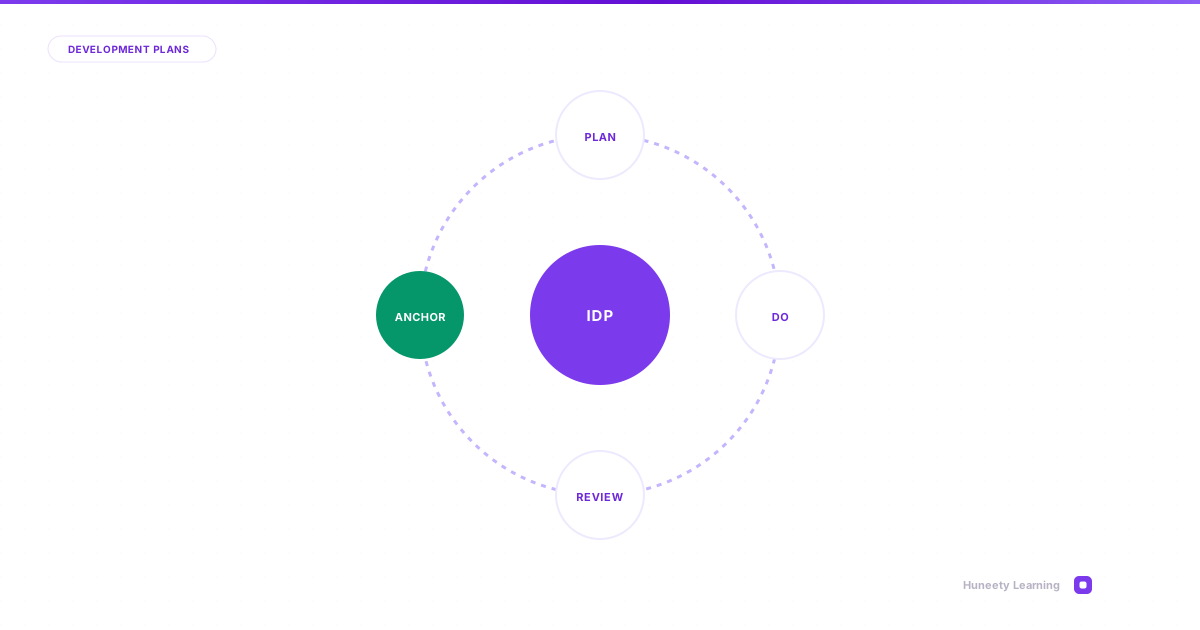
Most IDP programs don't fail at the framework. They fail at the launch. The framework is straightforward; the operational reality of getting managers, employees, and the performance system to actually run the cycle is where programs stall. This is the practical playbook for getting started with IDPs in an organization that has none today, with the three challenges every program runs into and the HR moves that solve them.
How do you start an IDP program from scratch? Five operational steps: define the foundations (role + goals), identify skill gaps via assessment, craft a 70/20/10 plan, support smooth execution with manager training, and evaluate results quarterly. The pitfalls aren't conceptual, they're operational. See Individual Development Plans for the framework definition; this article is the launch playbook.
What separates a launch that lands from one that stalls
After running IDP rollouts with HR teams across 12+ industries, the same gap shows up between programs that produce real development conversations and programs that produce filed forms. It's not about the template, the framework, or the platform. It's about three operational moves at launch.
An IDP launch that stalls
- HR rolls out a template, asks managers to use it
- Managers paste in last year's training requests
- Employees treat it as another HR form
- Reviewed annually as part of performance review
- PMS and IDP live in separate systems
An IDP launch that lands
- HR runs a 90-min manager training before rollout
- Each IDP starts from a competency assessment, not a wishlist
- Employees co-write the plan with their manager
- Reviewed quarterly in existing 1:1s
- IDP integrates with the performance management cycle
The three challenges every IDP program runs into
Three patterns produce most of the stalled IDPs we see in the field. Naming them upfront prevents the predictable surprises six months in.
Challenge 1: employee buy-in
An IDP without employee buy-in is a memo. To get buy-in, the employee needs to see how the plan connects to a career outcome they actually want, vertical promotion or horizontal mobility.
Challenge 2: manager commitment
Managers default to deprioritizing development work because it doesn't show up on their KPIs. Two structural fixes change that pattern.
- Train managers on how to draft and run an IDP, most have never been taught and feel exposed. A 90-minute workshop closes the gap.
- Install a quarterly 1:1 dedicated to IDP follow-up (monthly is better). Without a recurring slot, the IDP gets remembered annually, which is too slow.
Challenge 3: monitoring outside the performance management system
IDPs that live in a separate system get monitored separately, which means rarely. The fix is to combine development plans and goal-setting into one cycle.
- Include competencies as a key component of the PMS, not a parallel rating exercise.
- Integrate the IDP action plan into the employee's performance objectives so progress on the plan is progress on the goals.
- Set SMART objectives and KPIs that measure performance outputs, not training-completion counts.
The full IDP guide
What an IDP actually contains, end to end
Definitions, examples, and the deeper framework. This article focuses on launch operations; the pillar guide covers the underlying structure for readers new to IDPs.
Read the IDP guide
The 5 steps to launch an IDP program
Every company has its own variation, but the operational steps are the same. Run them in order.
Foundations
Define role + annual performance goals + competency map. Use AI or your own framework to map competencies per role.
Identify skill gaps
Run a competency review or 360 assessment. Get an unbiased view of current vs expected level.
Craft the plan
Translate gaps into a 70/20/10 action plan. Stretch assignments + coaching + targeted formal learning.
Smooth execution
Don't leave it to HR alone. Managers run quarterly check-ins; HR provides framework, training, and platform.
Evaluate and iterate
Re-assess at 9-12 months. Did the gap close? Adjust the plan or the program based on what worked.
Each of the 5 steps maps to actions in the 70-20-10 framework. For worked plan structure with a downloadable starting point, see filled-in IDP examples.
Built for HR teams
Automate IDPs from assessment data on Huneety
Skip the manual rollout. Generate IDPs from competency-gap data, integrate with the performance system, and track quarterly progress in one workspace. Designed for HR teams launching the first cycle.
See how Huneety launches IDPs
Frequently asked questions
Huneety helps HR teams roll out IDPs from competency assessment to quarterly tracking. Talk to our team about your launch plan.