Most individual development plans rely on a single lever: formal training. Send the employee to a course, check the box, move on. The 70-20-10 rule says that approach is backwards, and that the course is the smallest part of how people actually grow. This article explains what the rule is, why it holds up, and how to apply it to an IDP without making the three mistakes we see most often.
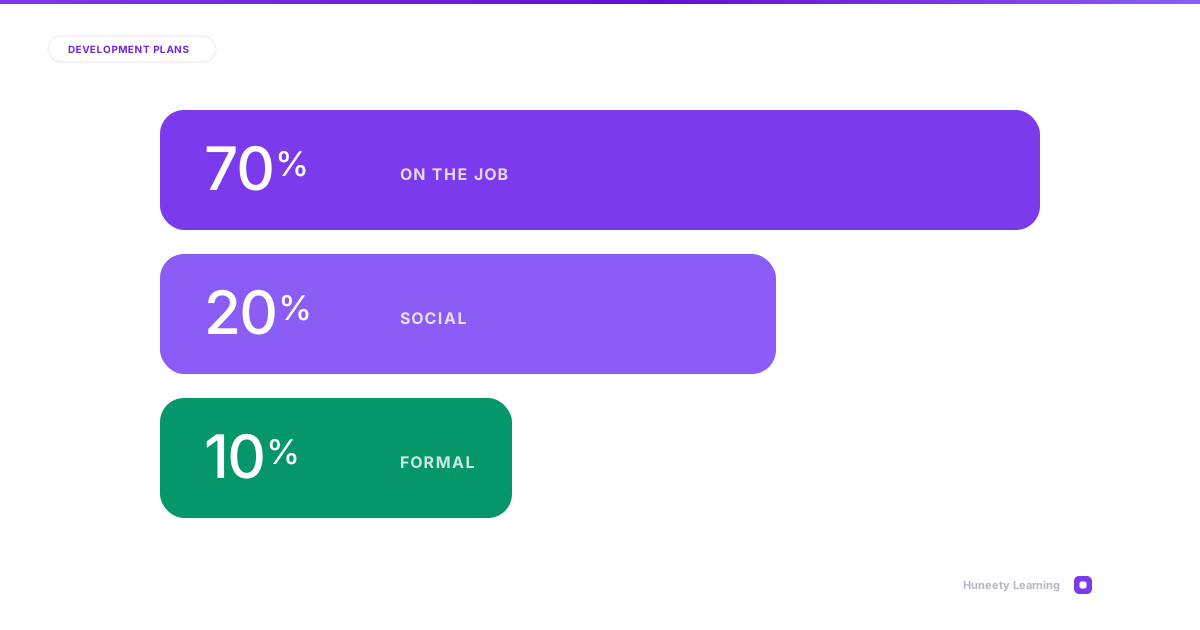
What is the 70-20-10 rule? A learning and development model that splits how people build skills into three parts: 70% comes from on-the-job experience, 20% from social learning (peers, mentors, managers), and 10% from formal training. It was developed at the Center for Creative Leadership in the mid-1990s and is now widely used to structure individual development plans.
Why formal learning alone doesn't work
If training alone built skills, HR would have solved the performance problem a decade ago. It hasn't. The frustration shows up in every C-suite and HR conversation: the return on training budgets is never quite visible, never quite tangible, never quite measurable enough. Formal learning is necessary, but on its own it is not sufficient. For the employee-side perspective on this disconnect, see why employees aren't learning.
There is a simple truth that gets ignored. A single top-down knowledge course will not develop a competency to the level where it changes business results, whether it lasts an hour, a day, or a week. Retention from a one-off session decays within weeks unless the employee applies the skill in context, gets feedback, and revisits the idea.
Four things about the workplace explain why the gap is so persistent.
- Employees spend more time at work than at home. They rely on workplace resources (time, peers, projects) to build skills, which means a course pulled out of that context has to work twice as hard to land.
- Technology is outpacing the half-life of competencies. The jobs of tomorrow will need skills that don't exist yet or are only emerging, and education systems will never adjust fast enough. The burden sits with the company.
- Information is everywhere, retention is not. People consume content from morning to night across entertainment, news, and notifications. Seeing content is not retaining it. Learning at work needs size, rhythm, repetition, and engagement to stick.
- Knowing and doing are different. In a business where disruption is the norm, employees have to react with new behaviors fast (a crisis, a pivot, a new regulation), and that kind of response requires practice rather than knowledge alone.
This is the gap the 70-20-10 rule closes. It treats the course as the smallest input and builds the rest of the learning experience around application and exchange.
What the 70-20-10 learning model says
The 70:20:10 learning model was developed by Morgan McCall, Robert Eichinger, and Michael Lombardo at the Center for Creative Leadership in the mid-1990s. Their research on high-performing managers found that people attribute roughly 70% of their career-relevant learning to hands-on experience, 20% to interactions with others, and only 10% to formal training.
The framework identifies three distinct ways people build skill.
Solving real problems, stretch assignments, tackling unfamiliar tasks. Where the bulk of skill development occurs.
Mentoring, coaching, peer feedback, cross-team collaboration. Learning through the people around you.
Courses, e-learning, workshops, structured reading. The smallest share, and the one most organizations over-invest in.
The 70%: on-the-job experience
This is the competency lab: stretch projects, new responsibilities, turning unfamiliar problems into assignments. It is the part of the 70/20/10 learning model that most companies assume will happen automatically, and most often it doesn't because no one designed it.
The 20%: social learning
This is the exchange layer: feedback from a peer after a presentation, a 30-minute conversation with a mentor, watching a colleague handle a tough customer. For this layer to work, it has to be structured rather than left to corridor conversations.
The 10%: formal learning
Courses, e-learning modules, workshops, books, podcasts. The content layer. It matters because it gives people vocabulary and frameworks. It fails when organizations treat it as the whole intervention rather than the on-ramp.
The three components are not sequential. They run in parallel and reinforce each other: the course introduces a concept, the stretch assignment forces its application, the mentor session corrects the execution. The on-the-job learning ratio is the most important of the three because it carries the largest share of real behavior change and is the component most organizations leave unstructured. For a worked illustration, see the 70-20-10 framework applied on our subtopic page.
The full guide
What an individual development plan actually contains
The pillar guide walks through every component of an IDP, from competency definition to follow-through, with examples for HR teams running their first program.
Read the IDP guide
The classic 3 mistakes HR teams make
After running development programs with HR teams across 12+ industries, three patterns come up again and again. They are worth naming because the fixes are simple once you see them.
The fix: treat the ratios as a sense check, not a specification. Different competencies have different natural blends. Learning a new software tool might run 40/10/50 because the formal component is denser; learning to delegate might run 85/15/0 because no course teaches it, only the doing. Blends like 65:25:10 or 55:15:30 are all legitimate. What matters is that the on-the-job and social components are present and designed, not whether the number hits 70.
The fix: budget the 70% and 20% as deliberately as the 10%. A stretch assignment is a line item that needs scoping, a sponsor, and a review cadence; a coaching relationship is a commitment with recurring calendar slots, a clear focus area, and feedback tracking. If you can't name the 70% and 20% actions on a development plan, you are running a 10/0/0 program with a 70-20-10 label.
The fix: treat every 70% action like a SMART project. Scope the deliverable, name the manager-in-the-middle, set a milestone review, debrief the learning. Acknowledge the growth moment explicitly: many companies fail to even tell the employee that a new assignment was designed as a learning opportunity. Say it out loud, and the assignment does double duty.
For a fuller list of IDP anti-patterns, see the top IDP mistakes companies make.
Applying 70-20-10 to an IDP
The rule is useful only when it turns into a plan. Below is how we design each component when building a 70/20/10 development plan with an HR team.
Designing the 70%
Stretch assignments are the backbone of the 70%. Done well, they do three things at once: close a competency gap, produce business value, and give the employee visibility. Done badly, they are a vague "take on more."
- Tie every assignment to a specific competency and a business objective. A project is a good stretch if it pushes the employee outside the comfort zone, connects them to another team, or forces a skill they haven't used before.
- Produce a SMART action plan. What will the employee deliver? By when? Reviewed by whom? Two milestones minimum.
- Name the learning explicitly. Tell the employee this is a development assignment, not a workload addition. That single sentence shifts how they approach it.
- Coach, don't just assign. The manager's job on a stretch assignment is more feedback-heavy than normal: weekly check-ins, not monthly.
Designing the 20%
Most organizations reduce social learning to "the manager gives feedback," and that is a fraction of what the 20% can do.
- Multiply feedback sources. Peers, internal clients, customers, subject-matter experts. Each sees a different angle. For leadership competencies, a structured 360 assessment is the clearest way to aggregate them.
- Build networking into the plan. Discussion groups, peer conferences, a monthly call with a counterpart in another company. Seeing how other organizations handle the same problem accelerates learning more than another course will.
- Pair people deliberately. A 30-minute monthly mentoring conversation, scheduled for the year, outperforms ad-hoc "reach out if you need help." Put it on the calendar.
Designing the 10%
Formal learning is a lever, not an intervention. Use it to seed vocabulary and frameworks the 70% will put to use.
- Link every course to a stretch assignment. If there is no application planned within 30 days of the course, skip the course.
- Think broader than classrooms. A book chapter, a 20-minute podcast, or a curated e-learning module can land as hard as a full-day workshop, and the employee actually completes them.
- Sequence before application. Formal content comes first as scaffolding; the 70% then puts it under load.
For HR teams standing up IDPs from scratch, this structure is the backbone. See getting started with IDPs for the operational playbook around it.
Identify the gap
Name the specific competency the IDP will close, with the role context.
Design the 70%
Two stretch assignments, scoped, with a manager-in-the-middle.
Design the 20%
Coaching and peer feedback on a recurring calendar, not ad-hoc.
Design the 10%
One course, one book, paced before the 70% applies them.
Set the cadence
Quarterly review with the manager. Track the 70% explicitly.
Re-assess
9-12 months later, measure the underlying competency. Did the gap close?
Free trial
Assess first, then build the plan
A free 360 finds the gaps, and the platform drafts the 70/20/10 actions from them. 7 days, one employee.
Get your free 360 assessment
Worked example: an IDP for a manager
To make the framework concrete, here is a 70/20/10 plan for a common competency gap. For a fuller treatment of manager-specific IDPs, see how to write an IDP for managers.
Person: mid-level manager, two years in role.
Gap: delegating effectively. Consistently redoes team output rather than coaching to standard.
Target outcome (6 months): delegates ownership of two substantial initiatives, spends less than 20% of time on direct contribution to team deliverables.
70%: on-the-job experience
- Q1 stretch: hand over ownership of the quarterly planning workshop to a senior team member; manager supports from the side, does not lead.
- Q2 stretch: delegate a cross-functional project from start to finish, with monthly milestone reviews and no day-to-day intervention.
- Weekly time-tracking to flag direct-contribution creep.
20%: social learning
- Bi-weekly 45-minute coaching with an internal senior peer who is recognized for delegation.
- Monthly feedback loop: anonymous 3-question pulse to the team on "where did I step in when I shouldn't have."
- Participate in a peer manager circle of four managers who meet monthly to share delegation challenges.
10%: formal learning
- One short course on coaching conversations (4 hours, asynchronous).
- One book on delegation and trust, completed in the first 30 days.
- Quarterly reading: one article from a named source, discussed at the coaching session.
The plan is twelve items. None of it is abstract. Each has a scope, a cadence, and a way to tell whether it happened.
At the 6-month review, the evidence sits across three streams: the quarterly time-tracking data shows whether direct-contribution creep dropped, the team pulse shows whether peers feel the shift, and the two delegated initiatives either landed or didn't. That mix of objective metric, peer signal, and observable outcome is what the 70 20 10 rule makes possible. A traditional course-only program has only one signal (did the employee complete the course), and that is not enough to close a behavioral gap.
For templates you can adapt to your own competencies, see IDP template examples.
Making 70-20-10 stick
A development plan that isn't reviewed isn't a development plan; it is a document. The post-training phase, the weeks and months after the course, the assignment, and the coaching session, is where skill either consolidates or fades.
Three patterns keep the plan alive.
- Quarterly review cadence. Not annual. Annual reviews are too slow for a 6-month competency push. Quarterly keeps the 70% on track and lets the blend adjust.
- Manager-owned, HR-supported. The direct manager runs the review; HR provides the template, the framework, and the escalation path when the plan stalls.
- Visible tracking. On-the-job learning is invisible by default. Making it visible (in a shared tool, in the performance system, in the one-on-one agenda) is what keeps the 70% from disappearing.
This is where most 70-20-10 programs break: the framework works, but the follow-through doesn't. In the platforms we build with HR teams, the IDP sits next to the assessment data that generated it, so gap, plan, and progress stay in one view.
Built for HR teams
Automate 70-20-10 action plans on Huneety
Generate IDPs from competency-gap data, with the 70/20/10 split pre-structured. Track stretch assignments, coaching cadence, and formal learning in one workspace.
See how it works
Frequently asked questions
Huneety helps HR teams run competency assessments, build development plans, and track progress across the full 70-20-10 blend. See how HR teams run 70-20-10 programs, or talk to our team about your own IDP rollout.