High performer vs high potential is the distinction that quietly breaks most succession plans. The two words get used as if they mean the same thing, so the best salesperson, the most reliable engineer, and the person who has been there longest all end up labelled "talent" and pushed toward leadership. Then six months after the promotion the team stalls, and nobody can explain why. The problem was never performance. The problem was treating a high performer as if they were automatically a high potential.
A high performer delivers excellence in their current role today. A high potential will deliver excellence in a larger, more complex role tomorrow. One is a statement about the present, the other a bet on the future, and the evidence you need for each is different. Getting the difference wrong is expensive, because a talent label comes with a fast lane to leadership: more visibility, more development budget, more salary, and a head start over everyone else. This guide separates the two cleanly, then shows how to reward and develop each one on purpose.
A high performer consistently delivers results in their current role and may be ready to promote now. A high potential delivers solid results today but is defined by learning agility and growth toward a bigger future role, usually ready in 12 to 18 months. Performance is about today. Potential is about trajectory.
The label without a definition
Call them talents, high potentials, HiPos, or successors. Your company, your vocabulary. The label is not the problem. The problem is that most organizations cannot explain what qualifies someone to receive it. When there is no shared definition, the talent review turns political fast. One manager nominates on performance, another on loyalty, a third on technical expertise, and nobody is evaluating the same thing.
We see the same scene in almost every talent review we run. A manager says, "I value this person, they are one of my best performers." Another manager replies, "I agree they perform well, but I would not call them a talent." The discussion stops there, because no one ever agreed on what a talent is. The result is a talent program filled with people who met different criteria, not because managers are careless, but because the organization never set a common bar in the first place.
High performer is not high potential
Start with the cleanest version of the distinction. A high performer is at the top of their current role: professional to expert competency level, consistently hitting 100 to 120 percent of their targets, ready for more responsibility today if the potential is there too. A high potential may only be delivering 80 to 100 percent right now and may sit below the bar on some competencies, but the trajectory is steep. They learn fast, absorb complexity, and grow into scope they have not held before.
The trap is assuming that current output predicts success in a bigger role. It does not. The skills that make someone the best individual contributor are not the skills that make them a good leader. A top performer promoted purely on results often discovers that the new job is no longer about being the best doer; it is about enabling others, and that is a different capability entirely.
High performer
- Delivers excellence now, at professional to expert level
- Consistently hits 100 to 120 percent of targets
- Often ready to promote today, with a proven track record
- Rewarded with a bonus for the results already delivered
- Your mandate: keep them challenged, recognized, and retained
High potential
- Will deliver excellence in a larger future role
- Hits 80 to 100 percent today but grows quickly
- Usually ready in 12 to 18 months with the right plan
- Rewarded with a bonus plus a salary increase for growing capability
- Your mandate: invest in development and stretch their learning agility
Both profiles are valuable. A high performer with limited potential is not a problem to fix; they are an expert to protect, and their best moves are usually horizontal ones that deepen mastery or broaden experience. A high performer who is also a high potential is the rarer case, and the one your succession plan depends on.
What the 9-box grid shows
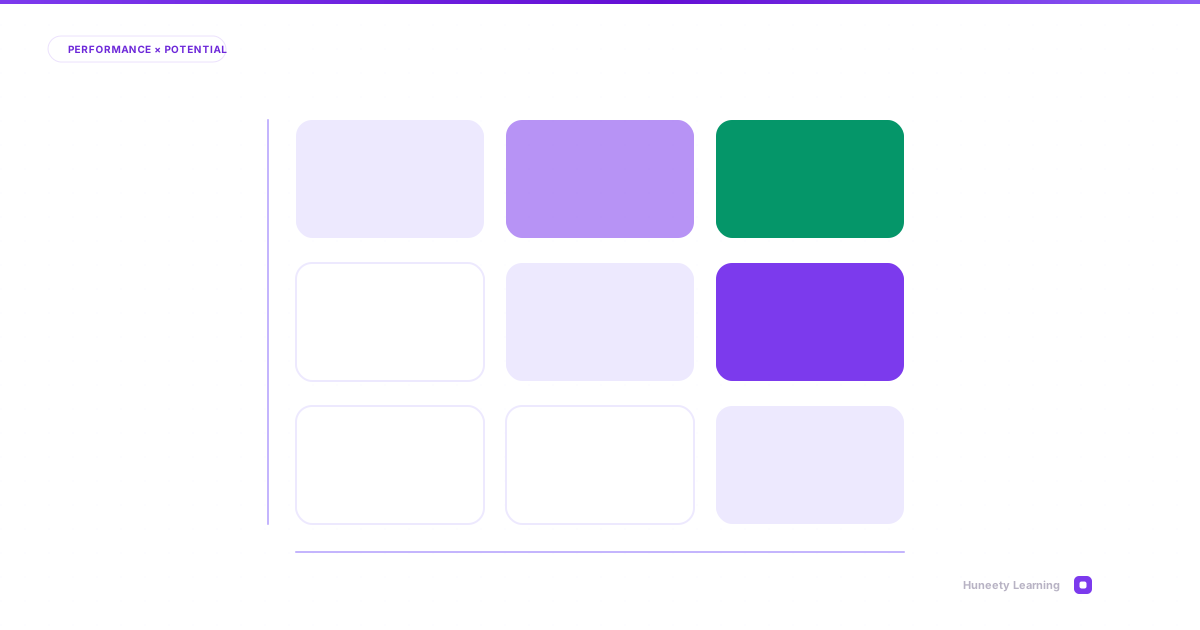
The fastest way to hold both axes in view at once is the 9-box grid: performance on one axis, potential on the other. We are not asking you to adopt the grid as gospel. We use it to make one point visible. Two people can post identical results and belong in completely different talent conversations, because their potential is different. The grid is also the same model that drives succession planning inside the Huneety platform, so the language stays consistent from the blog to the tool.
The visual tool that maps your entire talent landscape.
Performance
High Potential
Medium Potential
Low Potential
Potential: Role model + learning agility
Performance: KPI achievement + competency ratings
Good practices
- Pre-populate the grid with PMS and 360 data before any meeting
- Validate placements through the People Review, not manager self-reporting
- Present the final grid to CEO/CHRO as a strategic talent overview
- Reassess every cycle. People move between boxes.
- Tie each box to a specific development action (IDP, coaching, stretch assignment)
What to avoid
- Handing managers a blank grid to rank their people directly
- Confusing tenure or seniority with high potential
- Using last quarter's results instead of a full assessment cycle
- Treating placements as permanent. The grid is a snapshot, not a verdict.
- Running the grid without a People Review. No calibration = no value.
Read the grid by row. The bottom-right box is the high performer with limited potential: a solid professional who is excellent now and best developed through deeper expertise, not a rushed promotion. The top-right box is the star or successor: high on both axes, the profile you fast-track toward the next leadership role. The high performer in the middle row is doing great work but has not yet shown they can carry a bigger, more ambiguous remit. Same results, different plan.
Two rules keep the grid honest. Populate it with assessment data before any meeting, never as a blank grid handed to managers to rank people from memory. And validate placements through a calibration discussion, not a single manager’s self-report. Without that, the grid just launders opinion into a chart.
Succession planning
See how the 9-box fits the full plan
The grid is one step. The succession guide covers critical positions, talent identification, gap analysis, and the development plans that follow.
Read the guide
What a talent is not
When a company first sits down to define talent, it is usually easier to agree on what a talent is not. Three patterns disqualify a nomination, and each one shows up constantly.
Tenure is not potential. Five years in the same role is five years of evidence about the current role, not proof of readiness for a bigger one. As the saying goes, three years of experience is not the same as one year repeated three times. The question is whether the person has handled new complexity, not how long they have been comfortable.
The manager’s favorite is not automatically a talent. Managers nominate people they trust and enjoy working with, which is human and also a bias. Trust is not the same as the capability to succeed in a future role, and a talent pool built on rapport rather than evidence is just a popularity contest with a budget.
A toxic high performer is not a talent. Someone who delivers strong numbers while damaging the people around them is not a future leader; promoting them simply scales the damage. Results without the right behaviors are a long-term risk, not an asset. The only exception is a company whose values genuinely reward output at any cost, and that is rarely a company that wants to admit it.
The three non-negotiable criteria
A workable definition holds up under pressure. We define a talent as someone who demonstrates high performance, learning agility, and role-model behavior. All three must be present. Two out of three is not a talent; it is a development case or a retention risk.
Performance is the entry ticket, and it has to be documented. Use the full performance-management cycle: actual results against objectives and KPIs, validated over time rather than asserted in a meeting. If a strong year is not visible in the system, it is an opinion, not evidence. A minimum of about a year in the organization usually gives you a complete enough record to trust.
Role-model behavior is what separates a leader from a high-output individual. Use your company values to define what good behavior looks like, then actually evaluate against them. This is the moment a company finds out whether its values are real or just posters. Gather the evidence from more than the direct manager: cross-functional colleagues, internal stakeholders, and direct reports all see behavior the manager does not.
Learning agility is the most overlooked of the three, and the most predictive. Can the person grow beyond the current role, absorb ambiguity, and improve after feedback? Look at how they handle stretch assignments, how fast they pick up unfamiliar work, and whether they get better when challenged. Someone who is excellent going from A to B on repeat has not shown they can go from A to C. That jump is the whole question.
Reward performers and potentials differently
Once you can tell the two apart, you can stop rewarding them the same way, which is where a lot of talent strategy falls down. The reward should match what you are actually recognizing, and performance and potential call for different instruments.
A bonus rewards the result already delivered. It is tied to KPI achievement, it looks backward at the year that just happened, and it is the right tool for a high performer who is excellent in their current role. They delivered, you reward the delivery, and the bonus says thank you for this year.
A salary increase rewards growing capability. It is tied to competency progress and learning agility, and it looks forward: it is an investment in the larger contribution you expect as the person grows. That is why a high potential typically earns the bonus for this year’s results plus a salary increase that signals the company is backing their trajectory. The raise is not a reward for the past; it is a bet on the future.
Promotion sits on top of both. It is the decision you make only when sustained performance and demonstrated readiness for a bigger role line up. A bonus recognizes output, a salary increase recognizes development, and a promotion recognizes that someone is genuinely ready to operate at the next level. Keeping the three separate stops you from promoting a great performer who was never actually ready.
Promote learners not just performers
Put the criteria together and a single principle falls out. Stop promoting your best doers and start promoting your best learners. The best predictor of success at a higher level is not how well someone does today’s job; it is how they handle complexity they have never faced before. Output is necessary, but on its own it is the wrong thing to optimize a promotion for.
Stop promoting your best doers and start promoting your best learners. Past performance is the entry ticket. Learning agility is the golden ticket to a promotion.
Talent status should also be earned continuously, not awarded for life. Someone can enter the talent pool and, if they stop meeting the criteria, leave it. The same rules that let a person in should decide whether they stay. Treating the label as a permanent prize is how a strong talent program slowly curdles into entitlement, where status is expected rather than re-earned. The fix is transparency: agree on what good looks like, review against it, and have the courage to discuss behavior honestly. In most organizations the framework is not the problem; managerial courage is what is missing.
Who gets the one promotion
The distinction stops being abstract the moment two strong people want the same role. Consider a common case. One candidate has three years in the role, delivers 105 percent of target, deep expertise, the reliable go-to person, but does not reach for stretch work and is essentially at their ceiling. The other has 18 months, delivers 115 percent, is developing fast, recently led a cross-functional project, and keeps absorbing complexity. Both are excellent performers. Only one is clearly a high potential.
The high potential is usually the right promotion, because learning agility predicts success at the next level better than depth in the last one. The steady expert is genuinely valuable and may be exactly the person you do not want to move, since their value sits in the mastery they bring to the current role. This is not about turn-taking or fairness; it is about who is most likely to succeed in the bigger job. Hard decisions get easier when the evidence is in the system, because data settles what opinion would otherwise argue about.
From distinction to identification
Knowing the difference between a high performer and a high potential is the foundation. The next step is turning it into a repeatable identification process: a talent nomination form managers complete before the people review, evidence cross-checked against the performance system, and a calibration discussion that validates placements collectively rather than rubber-stamping the loudest manager.
From there, succession planning is about matching identified talents to the roles that actually carry risk, then closing the gaps with development plans. The mechanics of running that identification well live in the dedicated guide on identifying high-potential employees, and the question of which roles deserve a successor in the first place is covered in identifying critical positions. This article gives you the distinction those processes depend on.
Succession planning
Assess performance and potential with data
Huneety maps competencies, runs career-readiness 360s, and turns the gaps into 70/20/10 development plans, so high potentials are identified on evidence, not opinion.
See how it works
Frequently asked questions
Building a succession plan and want high potentials identified on evidence rather than opinion? See how Huneety assesses performance and potential together.