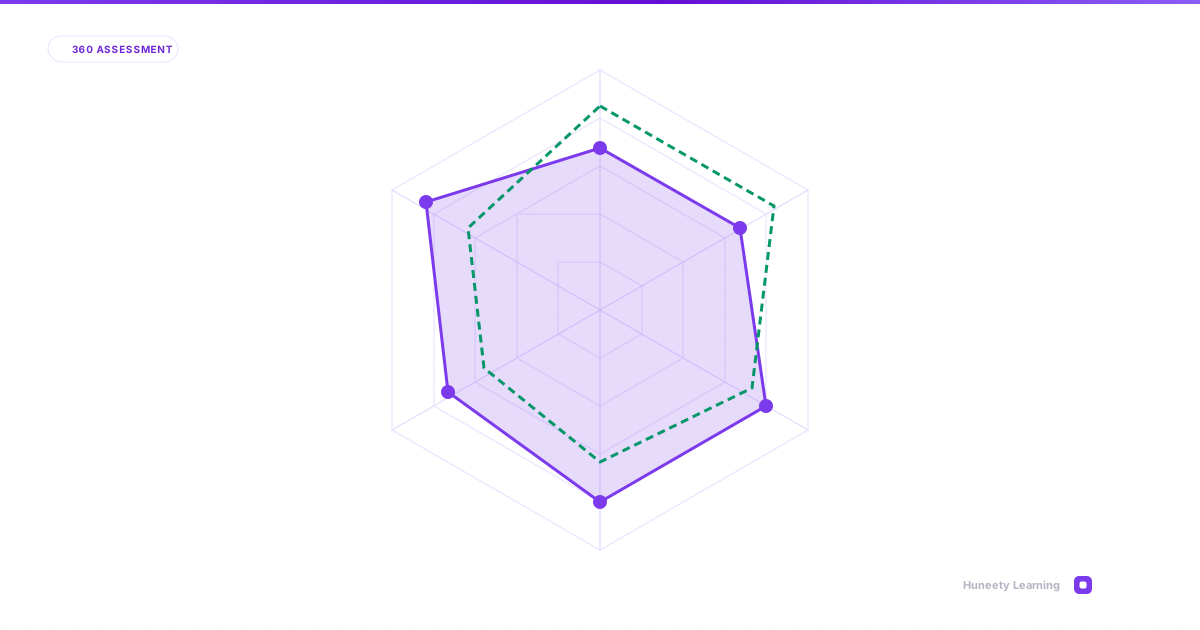
Leadership development is one of HR's hardest jobs, and one of the most expensive ones to get wrong. Programs, workshops, coaching budgets, executive offsites, and still the same patterns: "my manager doesn't listen," "I don't get clear direction," the leader who's confident in the boardroom and undermining trust on their own team. 360 feedback breaks this loop when it is designed for development rather than for performance theater. Below are 360 feedback examples for leaders, how the feedback drives development, and how to turn comments into a plan.
How does 360 feedback improve leadership development? By exposing blind spots that single-source feedback (the manager only) cannot see, by mapping the result to a competency framework so improvement is measurable, and by linking each finding to a development plan rather than a filed report. Run on a structured 360 platform with anonymity guarantees and a rater-group structure built in.
What makes 360 feedback different
Think of 360 feedback as holding up a mirror from multiple angles. A traditional review tells a leader what their manager thinks. A 360 assessment tells them what everyone they work with thinks: peers, direct reports, sometimes external stakeholders. The difference matters because leadership is not only about managing upward. It's about influence, trust, and credibility across the organization.
The leader’s own ratings, compared with everyone else’s
The line manager, optionally a senior executive
Direct reports, shown as a group
Peers and internal clients, external contacts optional
360 feedback examples for leaders
The comments below are illustrative, written for this guide rather than taken from a real report. Each one describes a behavior the rater saw and its effect, which is what makes a comment usable in a debrief. They cover three of the seven leadership competencies: leading and empowering teams, influential communication, and decision-making.
Delegation
When it works, raters write:
- “She handed me the supplier negotiation and only stepped in when I asked. I learned more that quarter than in the previous year.”
- “He explains why a task matters and what good looks like, then leaves the method to us.”
When it does not, raters write:
- “Tasks are delegated, but decisions are not. I still need approval for every small change, so work stalls when he is travelling.”
- “She takes work back when deadlines get tight. The team has stopped volunteering for stretch tasks.”
Listening
When it works, raters write:
- “In one-on-ones he asks what is blocking me and writes it down. The next week he comes back with an answer.”
- “She lets people finish before responding, even when she disagrees. Quieter team members speak up in her meetings.”
When it does not, raters write:
- “He often answers before the question is finished. People have stopped raising concerns in team meetings.”
- “She asks for input, but the decision seems made before the meeting. It feels like consultation for show.”
Decisions
When it works, raters write:
- “When priorities clash, he decides within the week and explains the trade-off, so the team knows what to drop.”
- “She makes a call with the data available and says when she will revisit it.”
When it does not, raters write:
- “Decisions wait for more data that never feels like enough. Two projects slipped a quarter because of it.”
- “He changes direction depending on who he spoke to last. We redo work without knowing why.”
Comments like these explain what a score means in practice. A low delegation rating says there is a gap; “tasks are delegated, but decisions are not” shows what to change. For how comments sit next to the scores, see how to read a 360 report.
How 360 feedback drives real leadership development
Four mechanisms separate 360 feedback from traditional review tools when it comes to leadership growth.
1. It creates self-awareness
Most leaders don't see themselves the way others do. Self-awareness is the foundation of emotional intelligence, and emotional intelligence is what separates average managers from leaders people actually want to follow. 360 feedback exposes blind spots. Leaders often resist at first; once they see patterns (multiple people flagging the same behavior), they can't ignore it.
2. It links directly to competency frameworks
When the organization has a leadership competency model, 360 feedback maps directly against it. Competencies like "collaboration," "coaching others," or "strategic thinking" can be rated from multiple perspectives. This gives HR measurable data to design targeted development plans. Instead of vague advice like "be a better communicator," managers see precisely where peers rate them lower than the baseline. Competency mapping is what turns 360 ratings into something development plans can act on.
- Invites quieter team members into key decisions
- Adjusts meeting format so all voices contribute, not just the loudest
- Names and credits ideas back to their original source
Without this kind of breakdown, ratings stay impressionistic. With it, raters can answer "yes, I observed this last quarter" or "no, this never happened." The data quality changes accordingly.
3. It supports continuous development, not one-off events
Workshops and training sessions are useful, but without reinforcement, most learning fades. 360 feedback provides an ongoing cycle: leaders get feedback, take action, and measure progress with a follow-up assessment. For HR, this is what allows tracking development over time. Leaders who engage seriously show measurable improvements across review cycles; the ones who don't are visible too.
4. It builds accountability
When a leader knows their team has rated their leadership behaviors, accountability is real. It's not HR asking for change; it's their people. Example: if multiple team members rate a leader low on "providing feedback," the prompt for action is unmistakable. That leader cannot dismiss it as an HR checkbox; they feel the weight of the team's voices.
The 360 system
The complete guide to 360 assessments
Methodology, the 5 rater groups, report structure, and the 5 mistakes that kill 360 programs. The full methodology behind the platform.
Explore 360 for leadership
Making 360 feedback work in your organization
360 feedback only improves leadership development when it's implemented well. Poorly designed processes backfire and create distrust. Four practices keep the program productive.
1. Create a safe environment
People won't give honest feedback if they fear consequences. HR must enforce anonymity and communicate clearly how feedback will be used. Leaders should understand the program is for growth, not punishment. If those guarantees aren't credible, the data won't be either.
2. Train leaders on receiving feedback
Receiving 360 feedback can be a shock. Some leaders get defensive, others get discouraged. HR should offer coaching to help leaders process the feedback constructively. The framing matters: this is not about judgment, it's about opportunity.
3. Link feedback to development plans
Feedback without action is wasted. HR guides managers to translate 360 insights into concrete IDPs. If a leader scores low on collaboration, the plan might include cross-functional projects or coaching on inclusive meeting practices. If they score low on mentoring, the plan might include structured mentoring assignments. The translation step is where most 360 programs lose value, see turning feedback into a 70-20-10 action plan for the structure to follow.
Free trial
Start with one leader, free
One full leadership 360 with report and IDP, plus the Academy manager modules. 7 days.
Get your free 360 assessment
4. Measure progress with a follow-up cycle
Run follow-up 360 assessments after 9-12 months. This creates a feedback loop: leaders act, teams notice, improvements are measured. The cycle is what makes 360 feedback improve leadership development continuously, not just once.
For the patterns that show up when the IDP handoff is missing or weak, see avoid these post-360 IDP traps. For the operational checklist before launching the 360 itself, see 5 pre-launch checks for 360 projects.
Built for HR teams
Run leadership 360s on Huneety
Multi-rater structure, branded reports, automatic IDP handoff, and follow-up cycles for measurable progress. Designed for HR teams running quarterly leadership development programs.
See how it works
Frequently asked questions
Huneety helps HR teams running leadership 360s with anonymity-by-default platform support, branded leadership reports, and direct IDP handoff. Talk to our team about your next leadership development cycle.