Most 360 feedback questions for leadership fail before the assessment opens: they ask raters to judge traits they cannot see. A peer can observe whether a leader explains the reasoning behind a decision. They cannot observe a “strategic mindset”.
This is an item bank: 40 rater-ready questions grouped by the seven leadership competencies in Huneety’s catalog, the scale to score them on, and the five question-writing mistakes that quietly corrupt results. One note on wording before the bank: most “questions” in a 360 are statements. Raters score how often they observe each behavior, so every item below is written as an observable statement.
Good 360 feedback questions for leadership describe one observable behavior each, phrased so a peer or direct report can score how often they see it. Group five to six items under each leadership competency, score them on a five-point frequency scale with an N/A option, and keep the questionnaire under 45 items.
What makes a question work
Three properties separate items that produce usable data from items that produce noise. First, one behavior per item: an item that bundles two behaviors cannot be scored when a leader does one well and the other badly. Second, observable action words: raters report what they saw, not what they infer about character. Third, rater fit: each rater group only receives items it can actually witness. If a rater cannot recall seeing the behavior, the item does not belong in their questionnaire.
Trait items (unusable data)
- Is a strategic thinker
- Has executive presence
- Shows leadership potential
- Is a good communicator
Behavior items (rater-ready)
- Translates strategy into clear team priorities
- Explains the reasoning behind decisions
- Adjusts the message to the audience in front of them
- Gives feedback within days of the event
The full guide
360-degree assessment: the complete guide
How to run a 360 end to end: rater selection, anonymity, launch cadence, and the five mistakes that kill 360 programs.
Read the guide
360 feedback questions by competency
The groups below follow Huneety’s leadership catalog: three pillars (Lead Self, Lead Others, Lead Results) broken into seven competencies. Pick the competencies that match the role’s framework rather than using all 40 items at once. Every item is scored “How often does this person…” on the frequency scale covered in the next section.
Self-awareness and self-management
The Lead Self pillar starts here. These items separate leaders who regulate themselves from leaders whose moods set the team’s weather.
- Stays composed when plans change at short notice.
- Acknowledges their own mistakes openly instead of shifting blame.
- Asks for feedback on their own leadership behavior.
- Changes their behavior after receiving critical feedback.
- Keeps the commitments they make to the team.
- Manages their own workload without letting pressure spill onto the team.
Resilience
Resilience items should reference recovery and steadiness, not toughness. Raters have usually watched at least one setback closely.
- Refocuses the team quickly after a setback.
- Keeps the team informed and steady during periods of uncertainty.
- Raises problems early instead of hiding them until they grow.
- Maintains quality standards when under sustained pressure.
- Treats failed attempts as input for the next one instead of looking for someone to blame.
Leading and empowering teams
Direct reports are the highest-signal rater group for these items. Peers see a different slice, which is why peer raters get a shorter version of this group.
- Delegates meaningful work, not only routine tasks.
- Makes clear who owns each decision.
- Lets the team choose how to reach an agreed outcome.
- Steps in to remove blockers when the team is stuck.
- Recognizes individual contributions in front of others.
- Runs meetings where quieter members get airtime.
Influential communication
Communication items drift into trait language faster than any other group. Keep every item anchored to a moment a rater can replay.
- Explains the reasoning behind decisions, not only the decision.
- Adjusts the message to the audience in front of them.
- Listens without interrupting when their view is challenged.
- Takes a clear position in disagreements instead of avoiding them.
- Keeps the team informed about changes that affect their work.
- Represents the team’s interests convincingly to senior management.
Developing people
Only direct reports can score most of these accurately. Give peers and managers the two or three items they genuinely witness.
- Holds regular one-on-ones that go beyond status updates.
- Gives specific feedback within days of the event, not months later.
- Creates stretch opportunities matched to each person’s goals.
- Discusses career direction with each team member at least twice a year.
- Shares their own know-how instead of guarding it.
- Follows up on agreed development actions.
Decision-making
The Lead Results pillar starts with how decisions get made, because raters remember decision moments long after they forget the outcome.
- Makes decisions at the pace the situation requires.
- Gathers input from the people closest to the problem before deciding.
- Names the trade-offs of a decision openly.
- Commits to decisions once made instead of reopening them.
- Escalates only what genuinely needs escalation.
- Corrects course quickly when new facts contradict the plan.
Execution and accountability
These items close the loop between what a leader announces and what the team experiences afterwards.
- Translates strategy into clear priorities for the team.
- Sets measurable goals the team understands.
- Follows through on what they announce.
- Holds team members accountable without blaming them in public.
- Reports progress and risks honestly to their own manager.
Score items on a frequency scale
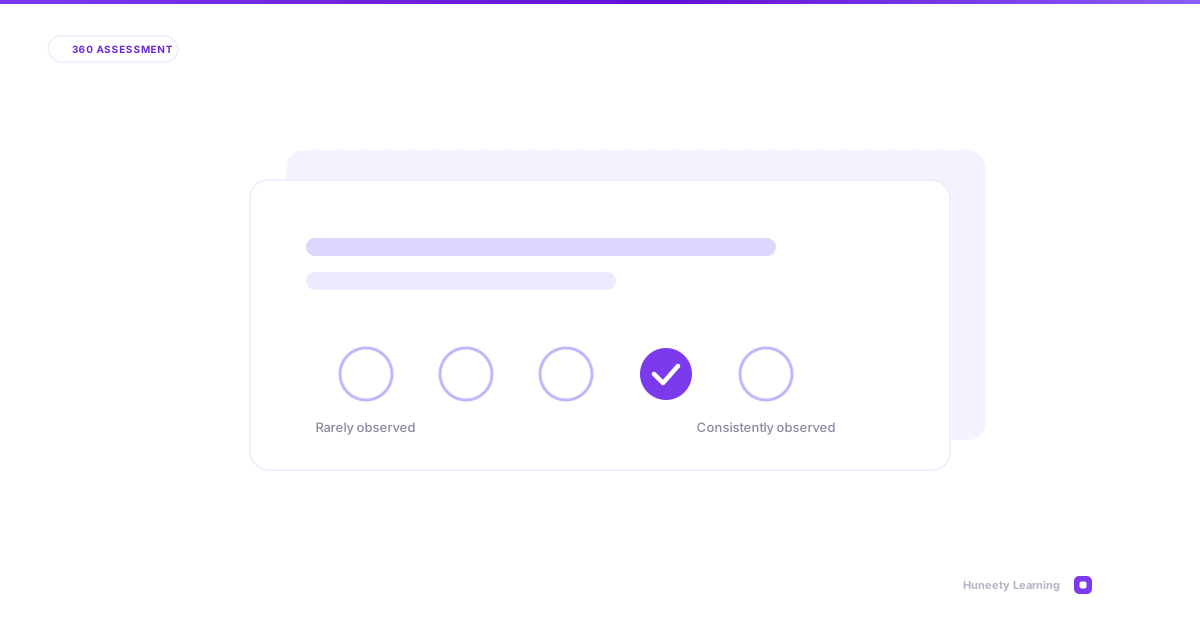
Agreement scales (“strongly disagree” to “strongly agree”) invite opinion, and opinion brings halo effects and polite central clustering. A frequency scale changes the question from “do you like this leader” to “how often have you seen this behavior”. A frequency scale asks raters to report what they saw, not to pass a verdict, and that is why the data holds up in a debrief.
Always include an N/A option (“not observed”). Forcing a score on an unseen behavior manufactures data. Item-level frequency scores then roll up into competency-level proficiency in the 360 report, where gaps between self and rater scores become the development conversation.
Agreement scale (1 to 5)
Invites opinion. Prone to halo effects and central clustering.
- Strongly disagree
- Disagree
- Neutral
- Agree
- Strongly agree
Frequency scale (1 to 5 plus N/A)
Anchors every score to observed behavior.
- Never
- Rarely
- Sometimes
- Often
- Consistently
- Not observed
Same five points. The left asks for a verdict, the right asks for an observation count.
Five anti-patterns that corrupt data
Anti-pattern 1: two behaviors in one item. “Communicates clearly and listens actively” cannot be scored when a leader does one and not the other. Split every “and” into two items or cut one half.
Anti-pattern 2: trait words instead of actions. “Strategic”, “inspiring” and “authentic” ask raters to judge character. Raters guess, and the guesses cluster in the middle of the scale.
Anti-pattern 3: items a rater group cannot see. Direct reports rarely watch board presentations, and peers rarely watch one-on-ones. Build per-group questionnaires instead of sending everyone everything. The self-evaluation mirrors the full set so perception gaps show up per item.
Anti-pattern 4: reverse-worded trick items. “Does not follow through on commitments” flips the scale mid-questionnaire. Attentive raters slow down, tired raters mis-score, and the item correlates with nothing.
Anti-pattern 5: the 60-item questionnaire. Fatigue produces straight-lining, where a rater gives the same score all the way down. Past roughly 45 items you are no longer collecting more data, you are collecting worse data.
Build the questionnaire in five steps
Turning the bank into a working questionnaire takes an afternoon, not a project. Pick six to eight competencies from the role’s framework. Select five to six items per competency, which lands the total between 30 and 45. Split the set by rater group: self and manager mirror the full set, peers and direct reports each score the subset they observe. Pilot with one team and cut any item that comes back N/A-heavy. Then lock the wording, because a repeat cycle with identical items is what makes year-over-year comparison possible.
When we run leadership 360s at Huneety, each role carries 8 to 12 competencies with a 60/40 behavioral-technical split, and Huna generates the observable items from the role’s job description, so HR teams edit a proposed questionnaire instead of writing one from a blank page.
On the platform
Run your leadership 360 with your own framework
Launch a 360 against your competency catalog: anonymous rater groups, per-group questionnaires, gap reports, and IDP recommendations in days.
Explore the platform
After the scores come back
Good items make the next two steps easier. The report shows perception gaps per competency, and the debrief conversation turns the two or three largest gaps into development actions. Items written as observable behaviors pay off here: the conversation starts from “raters rarely see you delegate meaningful work” instead of “you scored low on leadership”.
Common questions
Running leadership 360s across a whole organization? See how HR teams use Huneety to run the full cycle, from competency framework to rater campaigns to development plans.