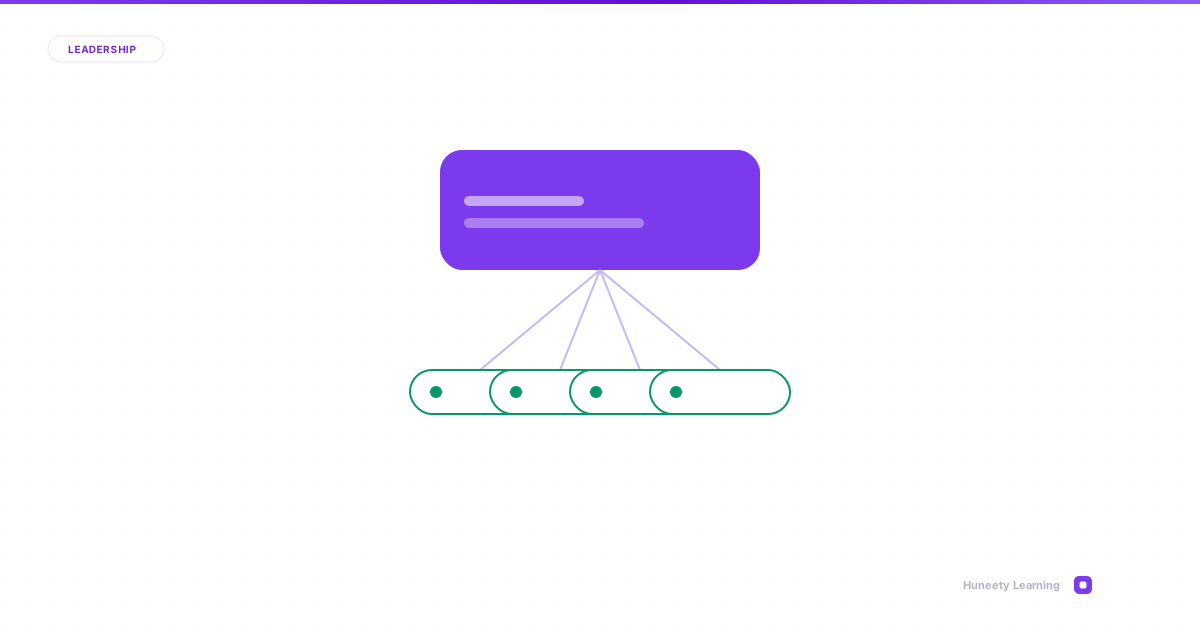
Most leadership programs work hard on the wrong unit. They define leadership competencies in abstract language, then assess people against words like "strategic vision" or "drives results." The terms feel important. They also describe nothing observable. The result is the same loop every time: ratings nobody trusts, development plans built on opinion, and learning that doesn't transfer because there was never a behavioral target to aim at. The fix is not better wording. The fix is to break each leadership competency into the underlying skills and behaviors that make it visible.
What is the difference between leadership competencies and skills? A leadership competency is a broad capability (such as coaching, decision-making, or change leadership) that combines several underlying skills, knowledge, and behaviors. A skill is a fine-grained, observable capacity (active listening, structured questioning, written feedback) that can be assessed and developed on its own. Competencies say what good looks like; skills say what to practice. Anchor every competency in 3 to 6 underlying skills with observable behaviors.
Competency and skill, defined
Start with the words. A competency is the combined utilization of abilities, skills, and knowledge to effectively solve a business problem. It is broad. "Coaching team members" is a competency: it pulls together listening, questioning, giving feedback, and reading group dynamics into one capability that shows up in real interactions. A competency answers what does effective look like in this role?
A skill is the capacity an individual must have to perform a job, role, function, task, or duty. Skills are fine-grained. Active listening, structured questioning, delivering written feedback, spotting groupthink: each is its own capacity that can be observed, taught, practiced, and assessed. Skills answer what does this person practice on Monday morning?
The relationship is hierarchical. A leadership competency contains several skills. Each skill is expressed through behaviors that an observer can describe without inference. Without that decomposition, a competency is just a label.
- Asks open questions before offering advice
- Names what they observe before interpreting it
- Surfaces development goals in 1:1s, not only at review time
- Gives written feedback within 48 hours of the moment
Supporting skills
Why fluffy competencies fail
Open most leadership frameworks and you will find labels like Strategic Vision, Drives Results, Executive Presence. Each one sounds important. None of them tells you what to look for. "Strategic Vision" can be evidence of brilliant long-range thinking, or evidence of avoiding execution. "Executive Presence" rewards the people who already pattern-match to the rater's mental model of a leader, which is exactly how bias enters performance decisions.
When a competency stays at the label level, three things break:
- Raters disagree because they are scoring different things under the same word.
- Employees can't recognize themselves in the framework, so feedback feels arbitrary or political.
- L&D can't build against it, because there is no specific skill or behavior to develop.
Break the competency down
The decomposition looks the same for every leadership competency. Take one capability. Name 3 to 6 underlying skills that combine to produce it. For each skill, write 1 to 2 observable behaviors that someone could see at work.
Take Decision-making under uncertainty. The fluffy version stops there. The useful version is:
- Frames the decision (skill: defining the question, scoping the trade-off).
- Gathers evidence proportionally (skill: knowing when to stop researching).
- Tests assumptions out loud (skill: structured questioning, red-teaming).
- Commits with a reversal plan (skill: writing the decision down with the conditions that would change it).
Now an assessor has something to look for. A coach has something to practice. The leader has something to recognize in their own week. The competency hasn't changed. The grain has.
- States the case for change in plain language, including what stays the same
- Names the people and processes most affected, before announcing timelines
- Holds a regular forum where the team can raise objections without retaliation
- Tracks the change against pre-committed indicators and reports them out loud
Supporting skills
Same shape. Different content. Delegation is the third example most leadership frameworks fluff. The capability hides four distinct skills that get conflated as "autonomy" or "trust." Pulled apart, they are coachable.
- Defines the outcome and the constraints in writing before assigning the work
- Names the decision rights, what the report can decide alone and what to escalate
- Sets check-in moments that match the risk level, not the leader's anxiety
- Resists taking the work back when the report's path differs from theirs
Supporting skills
Three competencies, three decompositions. The mechanic is portable. The vocabulary should not be: every organization has its own context, and the verbs and objects should reflect how that organization actually talks about leadership work.
Methodology reference
The 7 leadership competencies and 21 behaviors
The full pillar guide on structuring competencies, skills, and behavioral anchors so frameworks survive contact with reality.
See the competency reference
Anatomy of a non-fluffy definition
A definition that resists fluff has four parts. An action verb, a specific object, a measurable outcome or observable context, and a constraint that distinguishes the competent leader from a beginner. Drop any of the four and you are back to wallpaper.
The same applies at the skill level. A skill definition that says "Excellent communicator" is not a definition. A skill definition that says "Writes a one-page memo summarising a decision with rationale, alternatives considered, and reversal conditions" is one you can train, observe, and assess.
Fluffy (avoid)
- Strategic Vision: thinks ahead and inspires the team toward the future.
- Drives Results: consistently delivers high-impact outcomes.
- Executive Presence: commands the room with confidence and gravitas.
- Coaching: develops people and brings out their potential.
Concrete (use)
- Strategic Vision: writes a 12-month plan with named bets, owners, and the indicators that would force a change of plan.
- Drives Results: ships against committed milestones; renegotiates scope in writing when conditions change.
- Executive Presence: presents a position with a clear ask and the trade-off considered, in 5 minutes or less.
- Coaching: holds 1:1s on development goals every other week, with notes the report can refer back to.
Anchor each level with observable behaviors
Defining the competency is half the work. The other half is defining what each level of proficiency looks like. This is where most frameworks quietly collapse: the levels exist on paper, but the descriptions for each level are interchangeable, so raters end up scoring on impression. Behavioral anchors fix this. Take one skill, write one specific observable behavior per level on the Dreyfus 0 to 5 scale, and the rating becomes calibrated rather than felt.
Take the skill Delivering written feedback, which sits inside the Coaching competency. The same activity looks different at every level, and the differences are observable, not character traits, not gut reads.
L1 · Novice
Sends generic praise ("good job") or vague concerns; no specific incident, behavior, or outcome named.
L2 · Advanced beginner
Names a specific moment but mixes the behavior with the person ("you were unclear in standup" rather than "the standup update did not name the blocker").
L3 · Competent
Separates behavior from intent; states the impact; offers one concrete next step the report can act on this week.
L4 · Proficient
Closes the loop on previous feedback before opening new feedback; calibrates frequency to the report's preference; writes within 48 hours of the moment.
L5 · Expert
Builds the report's own feedback muscle: invites them to self-assess first, names the gap between self and observed, leaves space for the report to write the next step themselves.
Proficiency answers how well someone can do the behavior. For leadership, that is only half the story. The other half is how often they actually do it on the job. A leader can be capable of giving structured feedback at L4, and still leave their team in the dark because they only do it once a quarter. Capability without frequency does not show up on the team.
This is why leadership assessments at Huneety carry two axes. Proficiency on the Dreyfus 0 to 5 scale, anchored to observable behaviors at each level. Frequency on a five-point scale (Never, Rarely, Sometimes, Often, Always) for the same behaviors. The combination is the eye-opener. A leader rated proficient on coaching but rarely demonstrating it on the job is not a coaching skill gap; it is a coaching habit gap, and the development plan is completely different.
Proficiency (Dreyfus 0–5)
How well the leader can demonstrate the behavior
- Not required
- Novice
- Advanced beginner
- Competent
- Proficient
- Expert
Frequency (1–5)
How often the leader actually demonstrates it
- Never
- Rarely
- Sometimes
- Often
- Always
Both axes use behavioral anchors. The combination separates capability gaps from habit gaps.
On a 360 report this looks like two ratings per behavior, side by side. The mismatches are where the development conversation starts. High proficiency, low frequency means the leader has the skill but is not using it; the work is on cadence, not capability. Low proficiency, high frequency means the leader is showing up often but not skillfully; the work is coaching and practice. Same proficiency and frequency from the leader's self-rating but a divergent picture from peers and reports is the textbook self-awareness gap.
What sharper definitions reveal
When competencies decompose into skills with observable behaviors, three operational changes follow.
Engagement. Employees recognize themselves in concrete language in a way they cannot recognize themselves in "executive presence." The framework stops feeling like HR jargon imposed from above and starts feeling like a description of the work.
A defensible baseline. A baseline at the competency level is a vibe. A baseline at the skill and behavior level is a measurement. You can compare structured questioning across a population of 40 managers and act on the result. You cannot compare "strategic vision" across 40 managers without inviting the same bias the framework was supposed to remove.
Targeted development. Coaching plans, learning content, stretch assignments, and 70-20-10 development plans need a specific behavior to anchor against. "Get better at coaching" is not a development plan. "Hold a structured 1:1 every other week and write a one-line follow-up the report can refer to" is.
Why this matters for coaching and L&D
Coaching conversations get easier when the unit of work is a skill, not a competency. "Get better at coaching your team" is a year-long fog. "Hold a structured 1:1 every other week, write a one-line follow-up the report can refer to, close the loop on the previous action" is something a leader can practice next week and a coach can observe.
Learning content selection follows the same logic. A learning catalog tagged at the competency level ("Coaching", "Strategic Vision") forces L&D to push generic courses that span 12 hours and rarely transfer. A catalog tagged at the skill level ("Structured questioning", "Written feedback", "Decision framing") lets you assign a 45-minute module against the specific gap surfaced by the assessment. The same logic applies to 70-20-10 development plans: stretch assignments and on-the-job experiences only count as development when there is a specific behavior the leader is trying to practice.
Performance and development conversations stop being arguments about character. They become reviews of behavior, observed against an anchor that both parties saw before the work started. Individual development plans written this way are short, specific, and reviewable: each goal names a skill, a behavioral target on the Dreyfus scale, and the artifact that would prove movement.
Assessing both: baseline and perception
Once the framework is decomposed properly, the assessment question becomes interesting. Huneety supports two complementary modes, and most organizations need both.
Role baselines. For each leadership role, define the expected proficiency level on each competency and skill, on the Dreyfus 0 to 5 scale. This produces a role profile: what good looks like for a first-line manager versus a senior leader, in concrete behavioral terms. Assess people against the baseline and you get a gap analysis at both the competency and skill grain. The aggregate view tells the company where its leadership bench is thin and which behaviors to prioritize across the population.
360-degree perception. Self, peers, reports, and manager rate the same individual on the same competencies and behaviors. The point is not the score. The point is the gap between self-perception and the perception of others. That gap is where the development conversation actually starts. Behavioral anchors at each level mean raters are scoring observable conduct, not vibes, and the report becomes something a coach can work with rather than something the leader files away.
Run a leadership 360
360 assessments for leadership teams
Branded reports, behavioral anchors built into every rating, baseline plus perception in one project. From kickoff to development plans in days.
See how it works
Cross-cluster reading: competency framework examples by function (engineering, sales, leadership) and how 360 feedback improves leadership development.
Common questions about leadership competencies and skills
If your leadership framework still reads like a brochure, the assessment will too. The fastest way to recover is not to redesign the framework. It is to break each competency down to the skills and observable behaviors a coach could work with on Monday morning.