The starting point of an employee development plan is a conversation between the manager and his/her subordinate. This conversation is about where the employee is today and what they want to do next. If you are a manager looking at how to make an employee development plan, use the eight steps below to prepare the conversation, agree on a priority and follow up on the work. For the wider process and terminology, see our individual development plan guide.
1. Prepare for the development conversation
“What do you want to learn?” is a reasonable question to ask in a 1-1. The difficulty comes when the employee names a course and you both leave without discussing where they would use what they learn.
It is usually tempting for managers to propose or make decisions on behalf of their team. A first good practice is to prepare for the development conversation by scheduling a dedicated career 1-1 at least once a year. This dedicated 1-1 can also be scheduled whenever the employee’s responsibilities or ambitions change, but the point is to understand and acknowledge the career expectations of the team. For this intent, you can also set aside 15 to 20 minutes in an existing 1-1 to open the discussion.
The discussion should cover 2 things:
- Where does the employee stand in their current role?
- What would they like to do next?
If an employee wants to manage people and there is no role open, say so. You can still discuss the current requirements and which gaps should be covered to meet the current expectations of the role, or to develop on a project basis. Such conversations usually push managers to be creative. For example, could the subordinate practise setting objectives for two colleagues under your supervision if there is no other management path available at the moment in the company?
Some employees want to deepen their expertise or work with another team. Whether a career path is available or not in the company, employees still need to understand where they stand in the organisation. A sequence of assignments, each with a clear milestone, could give them a way forward in their current role.
What to prepare
Before the meeting, ask the employee to reflect on their current development, the obstacles that may be limiting their growth, and the key achievements that have contributed to their progress. Encourage them to identify responsibilities they would like to try and what is currently preventing them from taking on those responsibilities.
A good practice prior to the meeting is to review the employee's job description and current objectives beforehand. On your end, prepare examples of work that the employee does well and areas where they still need support. Try to link these examples to practical projects, development activities, or mentoring opportunities that could help the employee grow. If a promotion is being considered, discuss the process with HR before making any commitments.
Good practice: Send the agenda when you schedule the meeting. Give the employee time to think about their career before they sit down with you.
A 45-minute career 1-1
Use the agenda below as a starting point. The timings protect space for career aspirations and the support needed to act on them.
0–5 min · Check in
Energy, workload and a recent achievement.
5–15 min · Understand the starting point
Strengths and difficulties in recent work.
15–30 min · Explore career direction
Next 3–6 months and the longer-term ambition.
30–40 min · Agree the support
Assignments, access, time and manager commitments.
40–45 min · Confirm next actions
Who does what, by when, and the next meeting.
Start with the employee’s experience. Ask which recent piece of work they are proud of, what gave them energy and whether the current workload leaves room to learn.
Then use recent work to understand their starting point. Where are they comfortable? Where do they still need support? Bring specific examples of strengths and difficulties. Keep this part focused on development as this is not the space for a performance appraisal.
Give the most time to career direction to understand what the employee’s short-term and long-term career aspirations could be. For example, which responsibility would they like to try or get more confident with in the next three to six months? Looking one to three years ahead, do they want to deepen their expertise or explore another function? If they are unsure, agree on an assignment that lets them try the work.
Be clear about what you can arrange directly and what requires additional approval. For example, you might connect the employee with an internal expert to help strengthen their skills or build confidence. If a training course requires budget approval, coordinate with HR to explore the options and obtain approval. You can take an employee’s ambitions seriously while being transparent about what is possible and what needs further discussion or confirmation.
Before the end of the meeting, write down the direction you discussed and what each of you needs to check and when you will meet again. You can draft the individual development plan (IDP) once you have that information.
IDP guide
Individual development plans
How to set up and review an IDP.
Read the guide
2. Prioritise development using evidence
Once you understand the employee’s career aspirations, compare the competencies required for their current role with those needed for their desired responsibilities or future role. A formal competency assessment can help identify gaps and provide a clearer basis for prioritizing development areas.
Start with the reality of the job. If your company already has a competency framework or skills taxonomy, check that it still reflects the employee’s actual responsibilities. Reviewing and updating the job description is a practical way to identify how the role has evolved. If the employee is considering a specific career path, reviewing the job description of the target role can also provide an initial understanding of the competency gaps they need to bridge.
We recommend a maximum of 16 competencies for a role. If a shorter list describes the job well, use it. Select only what helps explain successful performance in that job. Our competency mapping guide explains how to connect competencies to role requirements.
Use a 360 assessment to broaden the view
HR usually coordinates 360° assessment projects. As a manager, your role is to work with HR to select participants who can provide relevant and constructive feedback. Prioritize colleagues who have directly observed the employee performing the responsibilities or demonstrating the competencies being assessed.
If you and another colleague rate the employee differently, take the time to understand what each of you observed. Different ratings may simply reflect different situations or experiences with the employee. Discussing these differences can provide a more balanced and accurate view of their competencies.
We recommend using Dreyfus-based proficiency levels so “proficient” refers to observable behaviour and autonomy in the role. Discuss the evidence behind a rating, especially where raters disagree. A score is an input to the conversation, not the whole decision.
The 360 assessment process guide covers how to prepare raters and run the feedback process.
Choose the priority that matters now
Not every competency gap needs to become a development priority. Focus on gaps that have the greatest impact on the employee’s current role or future career goals, and consider whether they have opportunities to practise these skills.
For example, an employee preparing for a management role may need to develop skills in setting objectives, giving feedback, and supporting team members. However, if they have never managed others, a lack of experience should not automatically be considered a lack of competency.
As a good practice, focus on three key development priorities. Developing new skills takes time and commitment, especially when employees need opportunities to practise and apply what they learn on the job.
3. Pre-draft the plan with HR
Once the 360° assessment is completed, review the findings with HR and prepare a first draft of the employee’s Individual Development Plan (IDP) to discuss with them.
The plan should clearly define:
- The competency to develop: For example, people management.
- The expected proficiency level: What the employee should be able to do independently or with support.
- The practical application: How the employee will develop and demonstrate competency through real work activities.
A good practice is to start with a clear, measurable outcome and work backwards to identify the steps and support needed to achieve it.
For example, an employee preparing for a management role could be tasked with leading a small project involving two colleagues, setting objectives, delegating tasks, and conducting regular progress reviews under the supervision of their manager.
HR can provide the development methodology, but as a manager, you are best placed to define the practical activities, resources, and opportunities needed to make the plan achievable. Make sure the employee has the necessary authority and support to carry out these activities.
Our guide to development plans for managers explores management responsibilities in more detail.
Agree the draft with the employee
Avoid simply sending the development plan to the employee by email. Instead, schedule a meeting to review the draft together, discuss the proposed activities, agree on deadlines, and clarify the support available.
Encourage the employee to share their feedback. They may identify conflicting priorities, unrealistic deadlines, or better opportunities to practise the targeted competencies.
The objective is to reach a mutual commitment: the employee agrees to carry out the development activities, and you commit to providing the necessary support. If any decisions or approvals are still pending, agree on who will follow up.
HR can help coordinate resources and monitor the overall process while your role as a manager is to provide practical opportunities, observe progress, and give regular feedback.
4. Turn the priority into SMART actions
A good Individual Development Plan (IDP) is essentially a SMART action plan: Specific, Measurable, Achievable, Relevant, and Time-bound. Both the overall development objective and the activities needed to achieve it should follow these principles.
A practical development plan can follow four steps:
- Objective: Define what the employee should be able to do, how success will be measured, and by when.
- Step 1 – Prepare: Build the necessary knowledge through training, observation, or mentoring.
- Step 2 – Practise: Apply the new skills with guidance and feedback from a manager or mentor.
- Step 3 – Apply: Demonstrate the competency through a real work assignment, with clear deliverables and deadlines.
- Step 4 – Review: Evaluate the results, provide feedback, and agree on the next development steps.
Keep each activity simple and actionable. Specify what needs to be done, by when, how success will be measured, and who will provide support. A few clear sentences are usually enough.
Remember that the plan should remain flexible. If responsibilities or business priorities change, review the activities with the employee while keeping the overall development objective in mind.
Combine practice, feedback and learning
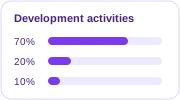
Use the 70/20/10 approach to combine three types of development activities:
- 70% Learning on the job: Assign practical projects or responsibilities where the employee can apply and develop the targeted competency.
- 20% Learning through others: Provide mentoring, coaching, observation, or peer feedback. Always identify someone responsible for guiding the employee and providing feedback throughout the assignment. This does not have to be you: consider involving other experienced colleagues or internal experts.
- 10% Formal learning: Recommend relevant training courses, books, audiobooks, or podcasts to build the knowledge needed for the assignment.
The percentages are guidelines, not strict rules. The priority is to create a balanced plan that combines learning with practical application.
Remember that completing a training course is not the final objective. What matters is whether the employee can apply what they have learned and demonstrate improvement in their work.
5. Commit the time and support
Employees need dedicated time to learn, practise, and complete their development activities. This is why the 70% part of the plan should ensure that the work is well connected to the current priorities on the job while aiming at a stretch. You want to ensure the employee has enough time and resources to complete the plan. For example, if a development activity requires two hours per week, agree on how to adjust their workload or priorities.
During the first two months, regularly check whether the time allocated is sufficient and adjust the plan if needed.
Be specific about the support you will provide. Instead of simply writing "Provide support," define clear commitments such as "Review the employee’s draft objectives by Friday and observe their first feedback session next Tuesday." This creates accountability for both the employee and the manager.
Another good practice is to inform relevant team members that the assignment is part of the employee’s development plan, particularly those directly involved. This helps create a supportive environment where colleagues understand the purpose of the assignment, provide constructive feedback, and give the employee room to practise, make mistakes, and improve.
6. Convert the conversation into an employee development plan
Let’s say the aim is to develop for a future management role.
Development priority: Setting clear objectives and monitoring team performance.
SMART objective: By the end of week 12, the employee will have led one supervised objective-setting and follow-up cycle with two colleagues. This includes defining SMART objectives, agreeing on action plans, conducting regular progress reviews, and providing constructive feedback.
The manager will evaluate the quality of the objectives, the follow-up process, and the employee’s ability to guide colleagues before deciding whether they are ready for greater management responsibilities.
Complete one lesson on SMART objectives. Draft two objectives and review them with the manager.
Observe two objective-setting conversations. Rehearse one conversation and apply the feedback.
Agree objectives and action plans with two colleagues. Hold two follow-ups per colleague and record next actions.
Review objectives, notes and feedback with the manager. Agree the next responsibility and any support still needed.
The manager protects two hours each week for preparation and review, integrated with the assignment, and agrees which existing work will be reassigned. The employee flags any workload conflict in the weekly update. They review the time commitment after the first month and again at the end of month two.
The review uses the actual objectives, action plans and meeting records. It also considers whether the employee listened, clarified expectations and followed through. Finishing all four steps does not automatically demonstrate readiness for a full management role. It provides evidence for the next decision.
Use the free Excel or Word IDP template to record the agreed plan. For other roles and priorities, see our individual development plan examples.
Huneety platform
Individual development plans
See how assessment results become a plan with assignments, coaching and formal learning.
See how it works
7. Review progress and agree the next step
Use your existing 1-1 meetings to follow up on the development plan agreed with the employee. If an assignment is delayed or no longer possible, address it early and agree on alternative activities to keep the employee’s development on track.
Important: Keep development in the usual 1-1 agenda
Creating additional monitoring processes often fails because of competing priorities. Instead, integrate development follow-ups into your existing monthly 1-1 meetings, using a consistent structure:
- Check-in: Discuss the employee’s well-being, workload, and current challenges.
- Performance review: Review KPIs, objectives, and progress on ongoing action plans.
- Development review: Go through the employee’s IDP, review completed activities, assess progress, and identify any obstacles.
- Feedback and coaching: Provide constructive feedback, encourage the employee to share their perspective, and offer guidance where needed.
- Next steps: Agree on clear actions, responsibilities, and deadlines before the next meeting.
You can adjust the time spent on each topic depending on the month’s priorities, but always make room to review the development plan.
For example, if the employee is preparing to take on a new responsibility, dedicate more time to discussing their progress and ask them to bring examples of their work for feedback.
Use GROW to coach the employee to achieve the roadmap
During these 1-1s, this is where you coach. Encourage employees to come prepared with examples of their work, progress updates, and proposed next steps. The GROW coaching model provides a simple structure to guide the discussion:
- Goal: What do you want to achieve by the next milestone?
- Reality: What have you accomplished so far, and what challenges have you faced?
- Options: What could you do differently? What other approaches could you try?
- Way forward: What will you do next, by when, and what support do you need?
Give employees time to reflect and propose their own solutions before offering advice. This helps build ownership, confidence, and problem-solving skills.
If progress is slower than expected, first understand why. Was the assignment clear? Did the employee have enough time, resources, and support? Use this discussion to decide whether to adjust the activities, provide additional guidance, or revise the timeline.
At the end of the meeting, agree on the next steps and commitments. The employee should document their actions while you confirm the support you will provide and the date of the next review.
8. Use assessment results to inform the next decision
Over time, compare the employee’s progress with their initial competency assessment and the expectations of their current or future role. Repeat assessments on a yearly basis to ensure progress is tracked efficiently. Here you want to ensure you are using consistent competency definitions and rating criteria.
A spider chart can help visualize progress by comparing current competency levels with those expected for a future role. For example, a three-year career goal can provide a long-term direction while the development plan focuses on achievable milestones over the next months to come.
Illustrative scores for a possible role in three years.
View all five scores
| Competency | Current | Target | Gap |
|---|---|---|---|
| Goal setting | 2 | 4 | 2 |
| Feedback | 2 | 4 | 2 |
| Coaching | 3 | 4 | 1 |
| Delegation | 2 | 4 | 2 |
| Follow-through | 3 | 4 | 1 |
Remember that developing a competency takes time. An employee cannot be expected to become an expert in six months. This is why breaking development objectives into smaller, progressive steps is essential. Each step should help the employee gain experience, build confidence, and gradually become more independent.
During each review, assess what the employee can now do independently and where they still need support. For example, they may be able to conduct a feedback conversation on their own but still need their manager to review the objectives or outcomes afterwards.
If a promotion is being considered, use the evidence collected throughout the development plan to evaluate the employee’s readiness. Remember that promotion decisions also depend on role availability and your company’s internal processes.
Turn assessment results into a development plan
Huneety connects competency assessment results with development planning. HR can select a priority gap and generate a draft IDP with on-the-job activities, learning through others and formal learning. Each plan focuses on one competency gap.
HR reviews the draft, adjusts the activities and deadlines, and can request manager approval before activating it. Sit down with the employee to check the assignment fits their workload and the support is available. You can use the platform for quarterly check-ins and your regular 1-1s to discuss the work in between.
Free trial
Turn assessment results into a development plan
Request a free trial with one 360 assessment. Once the assessment is complete, use the results to generate an IDP in Huneety.
Get your free 360 assessment